The Plum Creek Forest Reserve
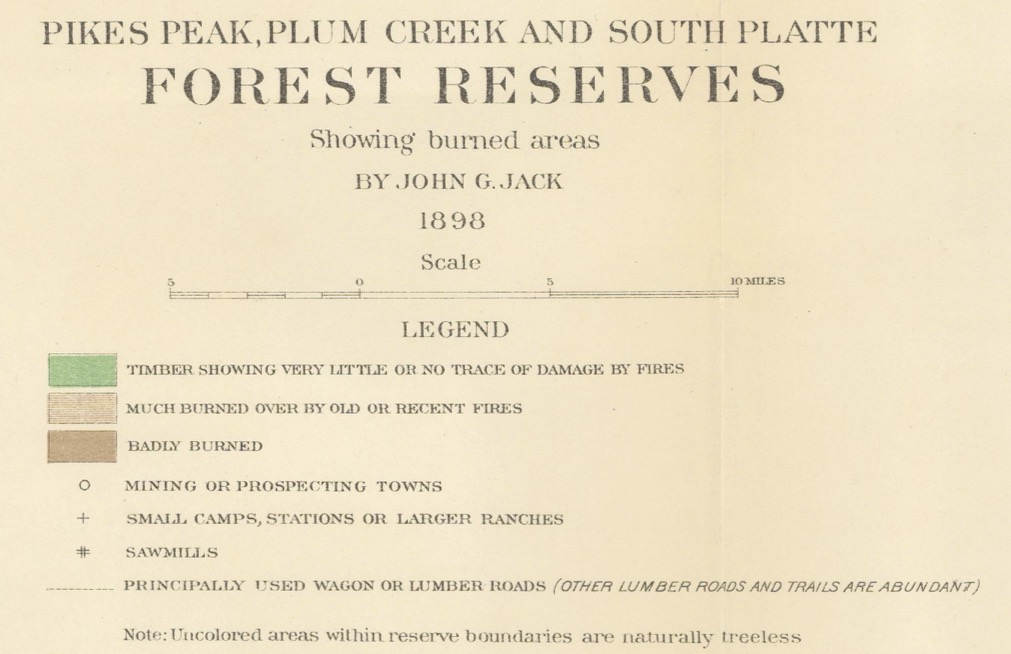
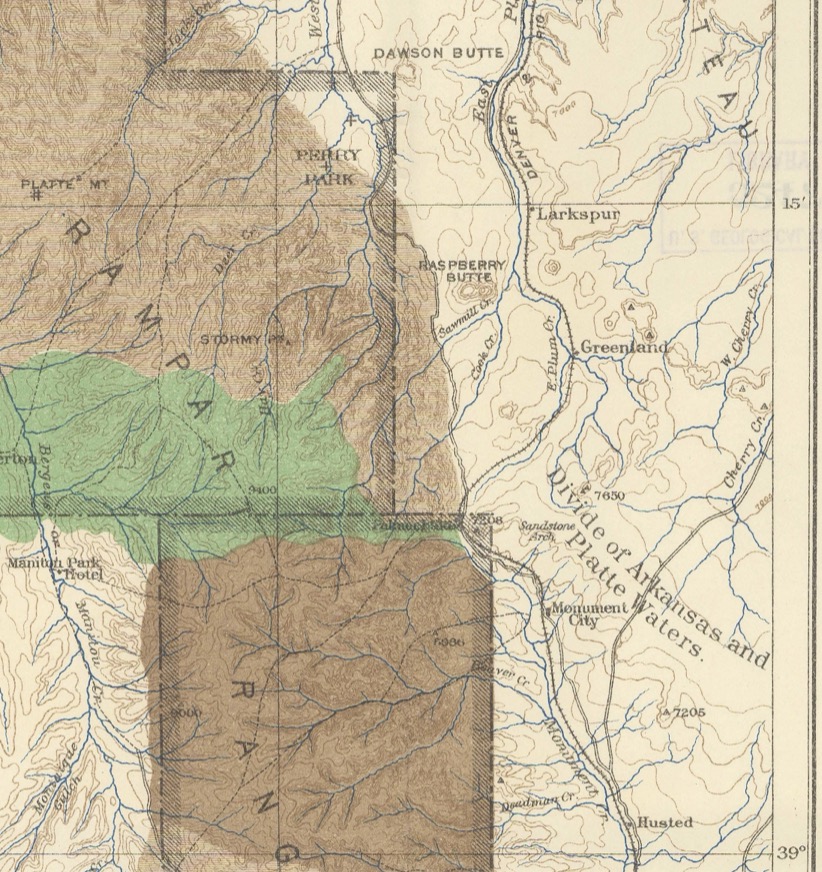
Protection of the timber resources in the Forest Reserves was of paramount importance to the region. Burned areas were mapped by John G. Jack in 1898. The map shows that much of the forest adjacent to Divide Country, including Perry Park, had been burned by that time.
The Nations First Forest Ranger
In 1898, the same year the map was published, 20-year-old William R Keutzer, rode into Denver for what was, unbeknownst to him, a political appointment. Billy Kreutzer’s father, Edward Kreutzer, was a Bavarian Forester who settled in Jarre Canyon in 1880 and was a cigar maker for a short time. Billy Kreutzer worked for H.H. Metcalf on a ranch near Sedalia. The Kreutzer homestead was designated as a historic landmark in 2000, and is privatley owned.
Based on that interview, Kreutzer was hired on the spot. Colonel W.T.S. May, the Forestry Superintendent for Colorado, stated, “Political endorsements be damned. I will hire who I want as a Ranger. A person who is in the hills and not tied to the job by political apron-strings, he will be a ranger free to do the things that ought to be done as he found them”. Billy Kreutzer was paid $50/month and had to provide his own horse, housing, food, and equipment. For more information see this article in the Castle Pines Connection.
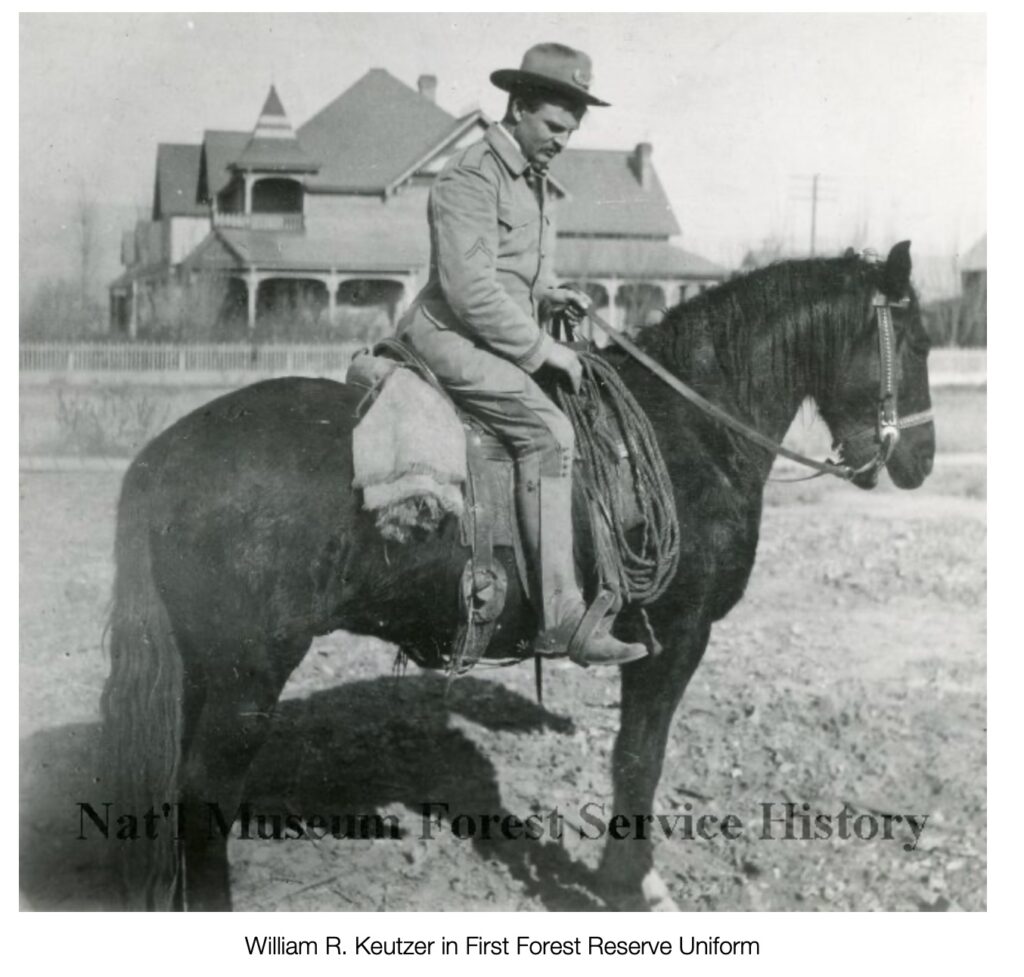
Kreutzer was ordered to “take horses as far as the Almighty will let you and get control of the forest fire situation….as much as possible. As to what you should do first, well, just get up there as soon as possible and put them out!”
Devils Head Lookout
The Great Fire of 1910, also known as the Big Burn or the Big Blowup, burned three million acres in Northern Idaho and Western Montana. This fire was the origin of the “10 A.M. Policy, ” which stated that all fires be extinguished by the next morning. The Devil’s Head Lookout Tower was established two years later, in 1912, at a site suggested by Billy Kreutzer. You can find the history of the tower on the Intermountain Histories site.
Harold Higginson, Lookout
The Casa Loma Ranch, north of Palmer Lake, was established by brothers Harold and Arthur Higginson in 1907. It is now part of the Greenland Open Space and the Spruce Mountain Ranch.
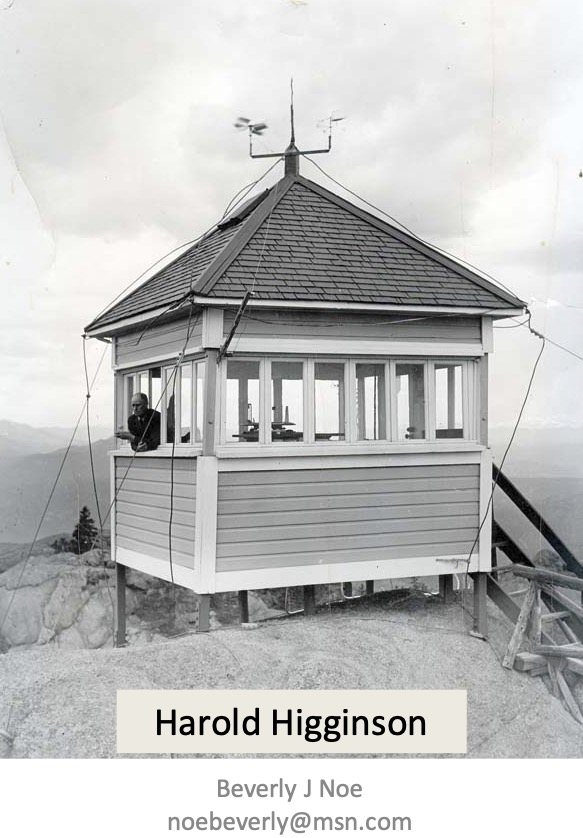
While living on the Higginson Ranch, Harold Higginson became a fire lookout at the Devil’s Head Fire Tower, where he worked 12 summers between 1929 and 1942. There was a small log cabin at the bottom of the rock. His wife Essie and their youngest daughter Janet spent one summer with him, where they picked wild strawberries and made jam on the little wood stove. Harold’s son Robert and Nellie Keehn were married at Devil’s Head on June 11, 1931. During the summer of 1933, Harold’s two oldest sons, Robert and Russell, worked for the United States Forest Service, helping construct a power line to the Devil’s Head Fire Lookout Station, which was accomplished with horses and mules.
Rising from the Flames:
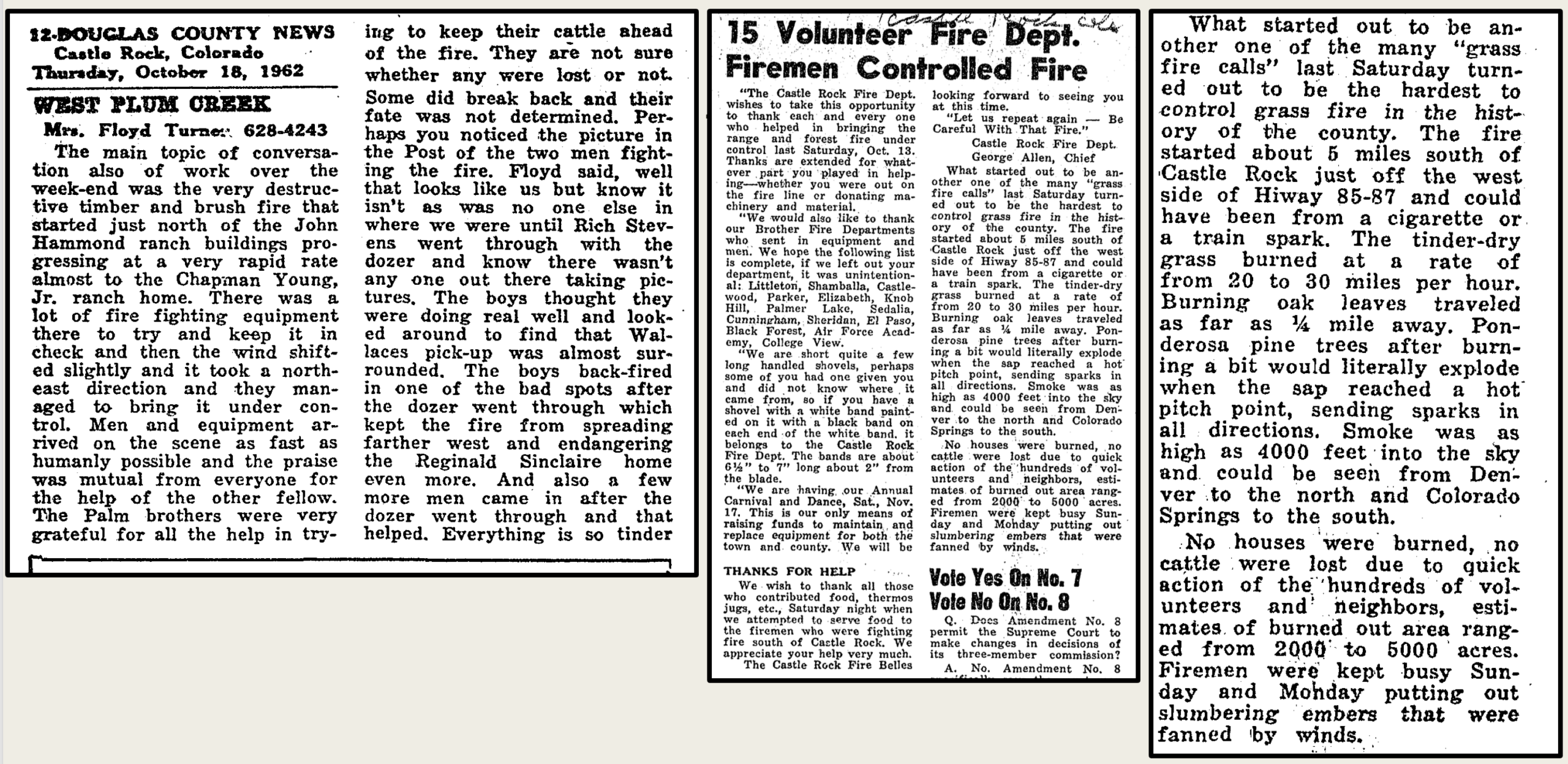
On October 13, 1962, a wildfire tore through the rugged terrain in the area of Tomah Road. The fire’s intensity required ingenuity on the fly. In one instance, a group of men, working in tandem with a bulldozer backfired in a critical area to stop the fire from spreading westward, saving a home.
This fire, fueled by tinder-dry conditions, was a wake-up call for the community, and underscored the areas vulnerability and the need for fire protection in the area.
Creation of Larkspur Volunteer Fire Department
On Tuesday, January 21st, 1964, the Larkspur Roping Club sponsored an organizational meeting at the Larkspur Schoolhouse to establish a volunteer fire department for the community. Roping Club President Louis Anderson Jr. called the meeting to order at 8:20 P.M. and introduced members of the Castle Rock Fire Department, who shared practical guidance on how to get started. Jack Higby advised that the first priority should be to organize and elect officers before turning to the question of equipment. The minutes from the Roping Club meeting are available.
Initially, the department relied entirely on community donations, operating on a meager budget. The equipment was humble—first a chemical tank on a cart, pulled by hand, and later, a military surplus forestry truck donated by the City of Fort Collins. The journey to retrieve this truck from Fort Collins was arduous, with the vehicle breaking down repeatedly on its way to Larkspur.
The department’s first firehouse, built on donated land, was a modest 3-bay structure funded by loans. Over time, it grew to 6 bays with a second-story meeting room, becoming the heart of the community’s fire protection efforts.
From Volunteers to a District
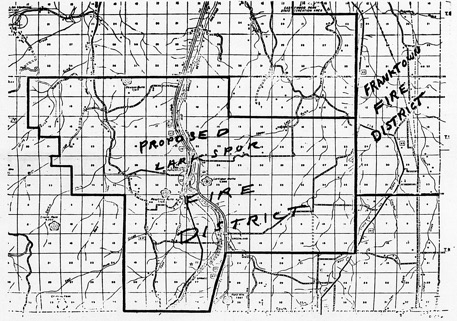
In 1971, the Larkspur Fire Protection District was officially established, allowing the department to collect property taxes and move beyond reliance on donations. This marked a turning point, providing a stable funding source to better serve the growing community.
Bald Mountain Fire Protection District
By 1982, another vulnerable area in Douglas County—the region from Best Road to El Paso County Road and east almost to Highway 83—was identified as a “no man’s land,” lacking fire protection coverage. Residents of this southeastern area near the Douglas-El Paso county line voted to create the Bald Mountain Fire Protection District. This new district served as a lifeline for the area, protecting homes and wildlands alike. Dave Wojnowski was the Fire Chief of the Bald Mountain Fire District and was responsible for constructino of the Bald Mountian Fire Station.
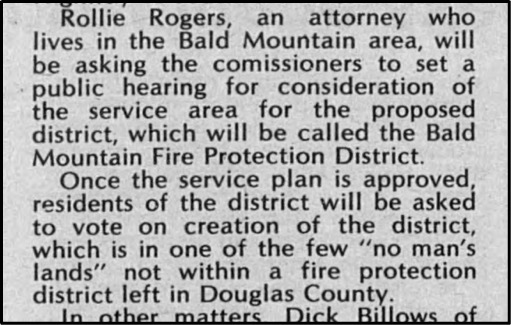
In 1991, the Bald Mountain Fire Protection District was dissolved and incorporated into the Larkspur Fire Protection District. This expansion unified fire protection efforts across the region, creating a more cohesive and efficient organization.
A Legacy of Community and Adaptation
In its early years, the Larkspur Volunteer Fire Department relied heavily on its residents. During the day, when most men worked outside the area, local women stepped in as primary first responders. In fact, it was a group of women and one elderly gentleman who first put the department’s new fire truck to use battling a blaze.
As the community grew, so did the department’s responsibilities. In 1997, the district adapted to the loss of commercial ambulance services by hiring full-time firefighters and paramedics. This transition led to the establishment of three rotating shifts and paramedic ambulances stationed at two locations.
Both Station 161 in Larkspur and Station 162 in Perry Park underwent major upgrades, with Station 161 receiving expanded living quarters, administrative offices, storage, and a firefighter gymnasium in 2010. These improvements reflected the district’s commitment to modernizing its facilities and providing top-tier emergency services.
Jay Alan Shaffer (1954-2001)
Jay Shaffer served from the Bald Mountain Fire Station as a Captain.He died while taking his wildland fire fitness test. Shaffer was also a veteran, a father and someone, according to the National Fallen Firefighters Foundation, who ”loved helping people in difficult situations–all the time and everywhere,” someone who showed “extreme patience and helpfulness to others.” He was 47. Captain Shaffer is memorialized outside Station 161 in Larkspur, at the Colorado Fallen Firefighters Memorial in Lakewood and at the National Fallen Firefighters Memorial in Emmitsburg, Maryland. Jay is the only LFPD Line of Duty Death. Gone but not forgotten.
Today’s Larkspur Fire Protection District
What began as a grassroots effort to fight fires with minimal tools has evolved into a professional, highly trained organization. The Larkspur Fire Protection District now stands ready to respond a wide array of emergencies, from structure and wildland fires to hazardous material incidents and advanced life support medical emergencies.
Through decades of growth and adaptation, the Larkspur Fire Protection District has remained true to its founding spirit: a community united in its determination to protect and serve. What started as a response to a devastating fire has become a a community institution.
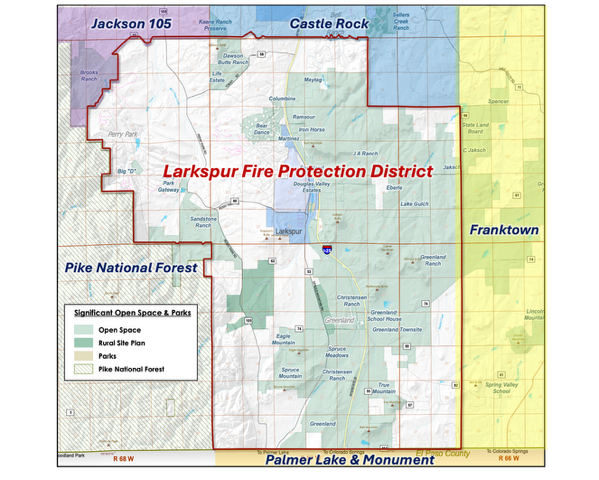
To learn more, visit the Larkspur Fire Protection District